




By Hon. E.O.A Omah
Egbeda is the most populous indigenous single community in Ikwerre ethnic group. Oral tradition reckons that Egbeda derives from “Egbe” and “Nda.” Egbe was the man and Nda, the wife. The father of Egbe was polygamous and had many children. The ones that are said to be of the same mother with Egbe are: Ele, Elu, Okpo and Egwa.
These communities refer to each other as “nwor-didi” an affectionate acronym for “brother” and up till today, one expects instant hospitality and security when found in any of these communities. They can never go to war or inflict any injury on one another. The names and historical identity of their parents, as well as the reasons for their spatial separation despite their agnatic relationship, are still subject to further investigation.
In his new home, Egbe married Nda and they produced many children. The number of children produced, the number of lineages that existed, and the nature of social organization which existed at that period are not known. They appear to be lost in obscurity. The only event which the people can remember is that there was a war which culminated in the bid for the people of Egbeda to seek refuge in other neighboring societies.
It is difficult to reconstruct how Egbeda was organised during the period before this Great War. Allusions to the events of that period could be merely conjectural historicism.
After a long period of sojourn in foreign lands, the descendants of Egbeda assumed that the tribulations were over, and it was time to retrace their home. The period of exile may have lasted for generations. The people settled in different communities, but communication among them was not inhibited and the characteristic wisdom of Egbeda people enabled them to teach their children that they had a glorious home somewhere.
These stories became incorporated into the people’s songs and folktales; thus, effectively passing them from one generation to another. For whatever reason, one generation felt the need to explore the original home and to exploit the prospect of their return. The pressure to leave must have been intensified by the continual hostility of the host communities. It is also plausible to assume that the people must have recognized that a continual stay in the foreign lands would result to their complete loss of ethnic identity.
The first person to undertake this homeward retreat was Ebuluku. He settled in the area currently occupied and inhabited by Omuibo. Ebuluku was reported to have arrived with a knife and a bag containing some mystical iron materials. With the knife, he cleared some portion of land and prepared a shrine where he planted some tree species and deposited some magical iron objects. These constituted relics of occupancy. This piece of land constitutes, till this day, ALI-EGBEDA – the collective shrine for the whole community of Egbeda.
It is not unlikely that Ebuluku persuaded Ogbo to follow him. He became the first person to settle in the area presently inhabited by Omuordu. Because of the cordial relationship that existed between them, Ebuluku accepted that the community shrine which he instituted would be jointly administered by them- Ogbo and Ebuluku.
Oji followed. Community life had already started to take shape before he arrived. However, he had spent reasonable period of time with Ebuluku and Ogbo before others arrived. But for whatever consideration, he was not incorporated into the ownership, administration propitiation of ALI-EGBEDA, the community shrine.
Iyanunu and the first person in Ibonimere arrived simultaneously. Iyanunu was a woman, and she came with her husband.
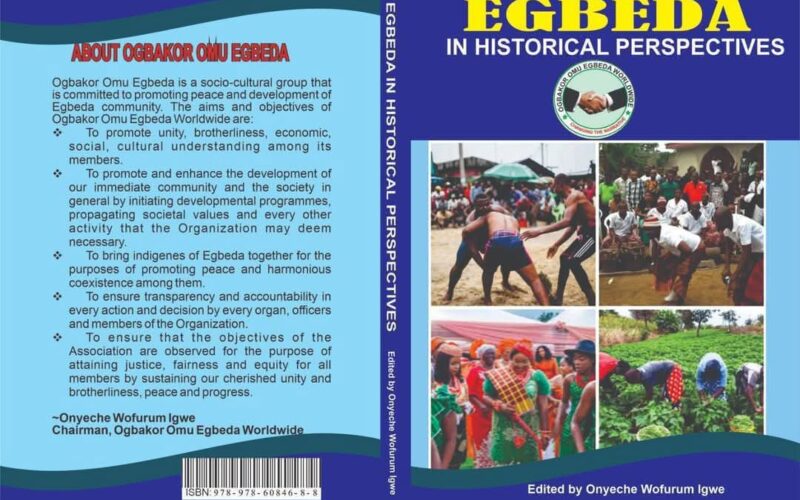
For the details, buy a copy of “Egbeda in Historical Perspectives.”
Highlights include: The Origin of Egbeda, Ayichi Festival, New Yam Festival, Wrestling Competition, The First Timers in various Fields, Simeon Boro Abraham, Egbeda Customs and Traditions, Egbeda Students Union, The History of Egbeda Chieftaincy Stool, Politics in Egbeda, Cultural Dances in Egbeda, and The Nine Villages and their Slogans, among others. Compiled by members of Ogbakor Omu Egbeda Worldwide. You can get the book on Amazon:
https://www.amazon.com/gp/aw/d/9786084683/
For more information, call 07031061646