


Nigeria’s major opposition parties have agreed to set aside internal rivalries and present a single, consensus presidential candidate ahead of the 2027 general elections in a coordinated bid to challenge the ruling All Progressives Congress (APC).
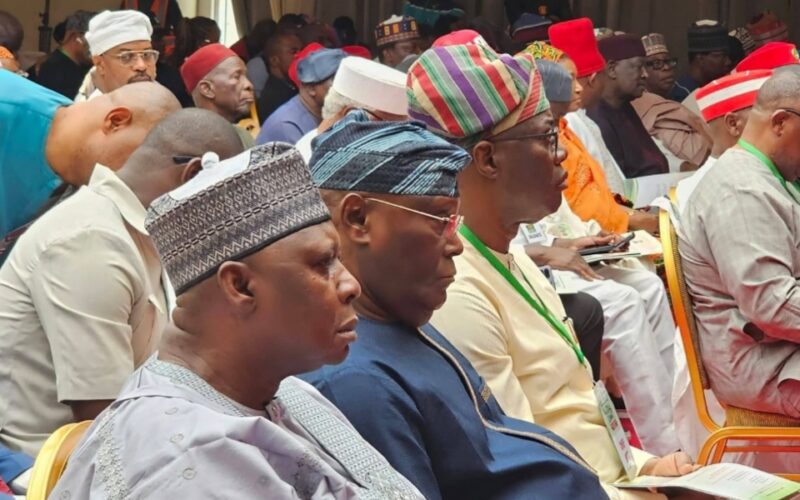
The resolution was reached at a national summit held on April 25, 2026, in Ibadan, the Oyo State capital, where a broad coalition of parties converged to chart a unified political strategy.
Among the parties represented were the Peoples Democratic Party (PDP), African Democratic Congress (ADC), Labour Party (LP), New Nigeria Peoples Party (NNPP), alongside several other smaller political platforms.
Reading the communiqué on behalf of the participating chairmen, Taminu Turaki (SAN), a factional PDP national chairman, described the move as a necessary step to “rescue” the country from what he termed the dominance of the ruling party.
“We shall work towards fielding one presidential candidate for the 2027 elections, which shall be agreed and supported by all participating opposition parties,” the communiqué stated.
Beyond the coalition plan, the summit also took a swipe at the Independent National Electoral Commission (INEC), passing a vote of no confidence on its chairman, Prof. Joash Amupitan.
The opposition accused the electoral umpire of partisanship and warned that his continued leadership could undermine the credibility of future elections.
They called for his replacement with what they described as a neutral figure capable of guaranteeing a transparent and credible electoral process.
The development signals a significant shift in Nigeria’s opposition politics, where fragmentation has historically weakened chances against incumbents. Whether the coalition can sustain unity and agree on a single candidate, however, remains a critical test as the 2027 race approaches.